Brad Francis, Deputy Assistant Senior Head Negotiator Of Sales Experience

I'm making this short story, which I wrote last year, free to read for the next 24 hours. If you'd like to take out a paying subscription to this site (which will allow you to read everything new I post, plus my entire archive), you can do so here for a minimum of £20 per year (or £2 per month if you prefer). If not, I still thank you for reading my work, and do rest assured there'll be another free newsletter or two along soon.
From the first time I heard his voice, I could tell Brad Francis was an oily character. It was the kind of voice that was always slipping out of your hand: one of those that, whatever their background, 90% of estate agents seem destined to end up with, a parody of well-spoken eloquence that was, in reality, entirely constructed from evasion and sickly sweet unguents and resin. If I’d had my way, I wouldn’t have had to put up with the displeasure of speaking to him at all. Unfortunately, I wanted the house he had been entrusted to sell, and I wanted it harder than anything I’d ever wanted in my short life.
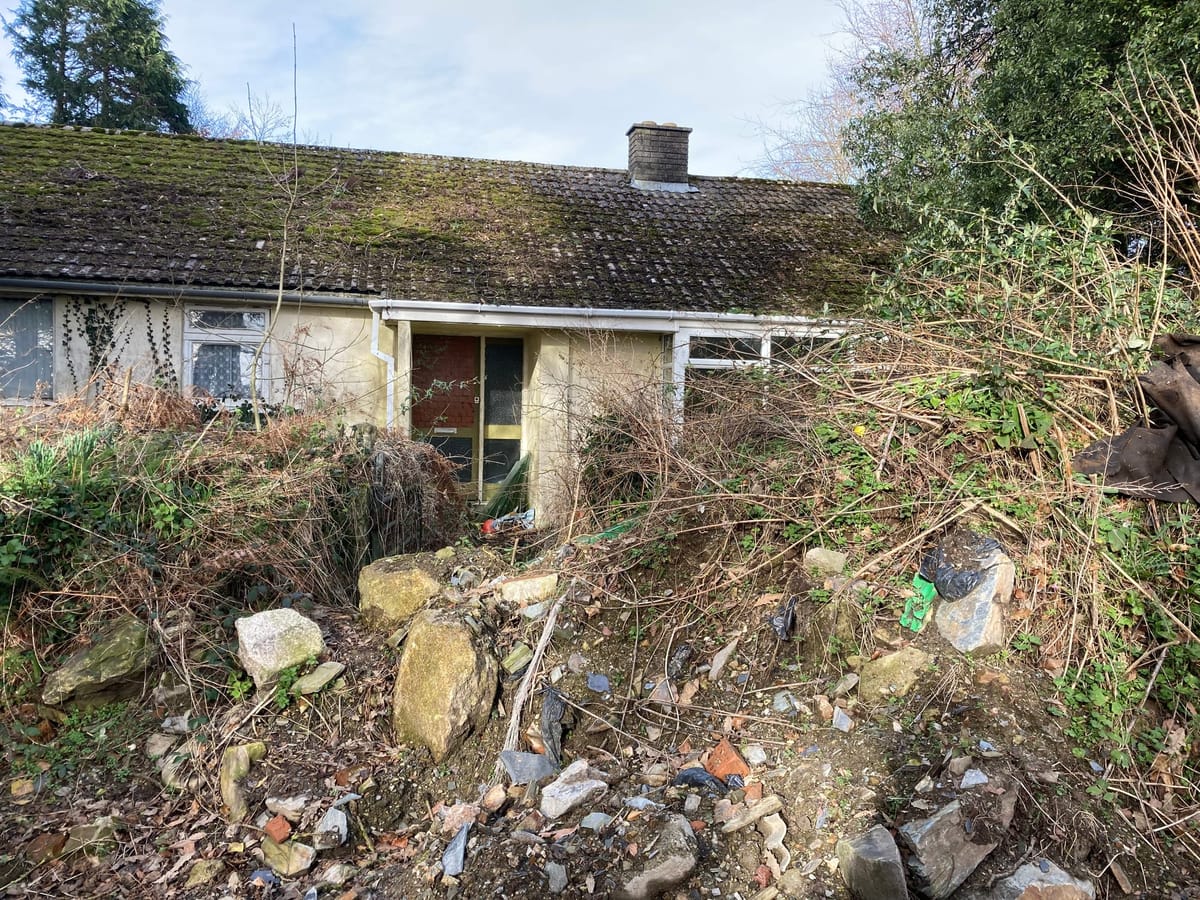
The idea was that I would live in the place for a year or two and hope that one day I would be able to afford to do the work it so desperately required, such as ripping out and replacing its fur-rimmed 1970s bath, incorporating its forlorn weather-lashed garage into a larger living area, installing a new kitchen and ridding the bedrooms of their unignorable odour of rotting crow. £400,000 was the highest offer I could possibly make and even that would require a loan from all three of my grandmas, a 35-year mortgage and every last penny of my savings. I suppose as a person in my 30s, in this day and age, I should have counted myself fortunate to be able to buy a house at all. But Francis was adamant that the vendors would not budge a penny below £450,000. For weeks, we did our uncomfortable little dance around our truths: mine being that I was dreaming beyond my means, and Francis’s being that the house had been on the market for a long time and the owner was clearly keener to sell than Francis was letting on.
In this time, during the detective work a person inevitably needs to do before a decision of this nature and magnitude, I had learned from the neighbours that the house’s architect, who had also been its original owner, had died in a fall from a ladder just as construction was being completed, and that in the neighbourhood the building had come to be associated with bad luck, which some said accounted for how long it had stood empty. I dismissed all this as meaningless superstition, gossip and poppycock and it had no impact on the positive feelings I got when standing in the living room, looking through the picture window towards the rooftops of town. At night, I mentally rehearsed the days I would spend there in the future with the intelligent, attractive woman I had not yet met but surely one day would, and the parties we would host there, populated by guests more tasteful and witty than the people I had encountered to this point in my life, although not quite as tasteful and witty as my oven-hot fictional wife.
During my fifth visit to the house with Francis, I finally saw signs of him beginning to come away from himself. He gave me the same slick patter as usual, all the stuff about resale value, how “buoyant” the market currently was and how blank canvases in this neighbourhood were “like gold dust”, but I could see a new tension around his small eyes, a downward curve to his glistening lips that I had not noticed before. The face speaking to me was not the same one I had seen on the Instagram page where, via a series of beaming front door selfies, he recorded his sales triumphs.
Perhaps he’d had some bad news that morning? More likely I had simply worn him down with my questions and refusal to submit to his lubricious tactics. I suspect I had become every bit as irritating to him as he was to me. He’d already decided I wasn’t his kind when, during my first viewing of the house, he’d asked if I played golf and I’d answered vigorously in the negative, but the full list of the things he disliked about me was plain to see in our every exchange: my infuriating patience, the mud patch on my 12 years out-of-fashion jeans, my refusal to call the house “the property”, the nonsensical slogans on my t-shirts, and above all the very fact that I was still here, not quite allowing him to successfully do his job. All the other enthusiastic buyers he had promised had not materialised and the inaccuracy of his own predictions was eating him up. Glancing at him, I felt like I was watching a couple of letters fall loose from the logo of a shiny corporate building, presaging its inexorable decline.
“I had another conversation with my client this morning and his position has changed somewhat,” he said, as he followed me out onto the terrace beyond the building’s dated, leaf-plastered conservatory. “Myself and himself discussed it at some length and it seems that, in the event of a quick sale, he might be willling to move closer to 430k.”
I said nothing, merely squinting at a couple of broken fence panels on the boundary that separated the garden from a thriving reserve belonging to the Royal Society For The Preservation Of Birds. Originally, it had been a gravel pit, used for the construction of the motorway that bisected the county. Now it was the largest and most revered wetland in the entire region. In the distance, in the fuzzy light, we saw a winged shape coming into land on a small island in one of the reserve’s seven ponds.
“Look at that,” said Francis. “A nice little swan.”
“It’s an egret,” I said.
“Same thing,” he said. “All birds.”
“Also, it’s ‘me’ and ‘him’ and ‘you’.”
“Huh?”
“Every time I talk to you, you say ‘myself’ and ‘himself’ and ‘yourself’ when you can just say ‘me’ and ‘him’ and ‘you’. It’s probably not your fault. I suspect you heard another estate agent doing it early on in your career and thought it made them sound intelligent and important.”
Feeling I had him on the ropes now, I expressed a wish to have one more look at the bedrooms and he trudged obediently ahead of me back into the house. For the first time, I noticed he was a couple of inches shorter than me: something I would never have suspected the first time I saw him at his office desk leaning back in his swivel chair and assessing me, a thin finger pressed to each hip. As we climbed the stairs we noticed that the loft door was open, and a retractable metal ladder extended down from it to the landing. “That’s strange,” said Francis. “Who could have done that? I don’t remember it being there yesterday.”
He gave the ladder a half-hearted push, what could barely be called a push at all, and it did not budge. “Oh well,” he said. “These things can get quite stiff when they’re out of use. I’ll sort that later, after you’ve gone. Now, time is pressing on, and I have a 4.30 in Winchley Steepleton. What do you need me to tell you?”
I don’t know quite what made me step in and try to move the ladder myself. Perhaps it was just that customary yearning of mine, so at odds with my appearance, to exist 24-7 in a tidy environment. Equally, though, it could have been what for me was a rare moment of macho one-upmanship: the knowledge that I already had got the edge on Francis, coupled with some primal animalistic instinct that, by humiliating him via my greater physical strength, I could fully press my advantage home. But the second I assertively put my hands on the metal and gave it an upward shove, he was on me, pulling at my shirt, my jeans, my hair, my earlobes. From his mouth emerged the most desperate wail: a noise that sounded, at first, somewhere halfway between “Stop!” and “Nooooo!” but, as if conscious of its own impotence and futility, became something far more garbled and pitiful. My initial impression was that I was witnessing a man in the full throes of a mental breakdown but, as the the walls began to shake, plaster fell from the ceiling and an unpleasant bakelite lampshade came violently out of its socket and smashed on the stairway below us, I realised I had inadvertently triggered something far more cataclysmic and frightening.
Thankfully we made it out onto the lawn before the roof fully collapsed. Beside me, sitting on the grass where I’d placed him, Francis reached for an electronic cigarette. As I watched roof beams and lintels crash to the ground not forty yards away, I was struck with the certain realisation that if I had not scooped him up into my arms as quickly as I had, he might well be dead. Yet though his demeanour was that of a broken man it was not that of a surprised one. He displayed no sign of shock as the house’s remains began to swirl in circles of furious of black dust and ash, nor when, from that vortex, an equally black and granulated figure emerged: a terrible, beckoning, mouthless, eyeless, noseless form that was human only in size and approximate shape. If I’d had to describe the emotion on Francis’s face, the word I would have used was not terror but defeat.
What he did next was perhaps the most unlikely event of the entire afternoon: he raised himself off the ground, brushed the brick dust off his heavily singed grey suit, and began to walk purposefully in the figure’s direction.
What happens, when you are faced with what appears to be a tear in the wall of reality? I will tell you this, from firsthand experience: you do not stop to write an analytical essay about it. Perhaps many in my position would at this point have got to their feet, jumped the broken fence panels and ran as fast as their legs would take them back to all that was mundane, safe and normal. But what I was seeing was quite simply too compelling. The unpredictable, thunderous nature of its narrative was not something I could turn away from. So I sat on the spongy, ash-flecked turf of what I’d hoped would be the first garden I had ever owned and watched as Francis reached the fuzzy-edged black figure and began to converse with it. Although the furious noise of the swirling debris had abated a fraction by now, it was still too loud for me to catch any of the conversation. All I could tell, going on hand gestures, posture and the fact that Francis had not been smote down or incinerated, was that it seemed to be of a reasonably amicable nature.
About five minutes went by before Francis returned to my side. When he did, he had a additional odour about him, not dissimilar to that rotting crow smell I’d become familiar with in my explorations of the house’s bedrooms, but it was largely still blocked out by the chemical raspberry waft of his vape stick. He took a casual drag, filling my olfactory tubes with a supplementary level of evil.
“Okay so the latest news is that I’ve been discussing the situation with my client,” he said. “And he absolutely will not take less than three hundred pounds.”