Eaten Words: Memories Of A 1990s Fanzine Editor

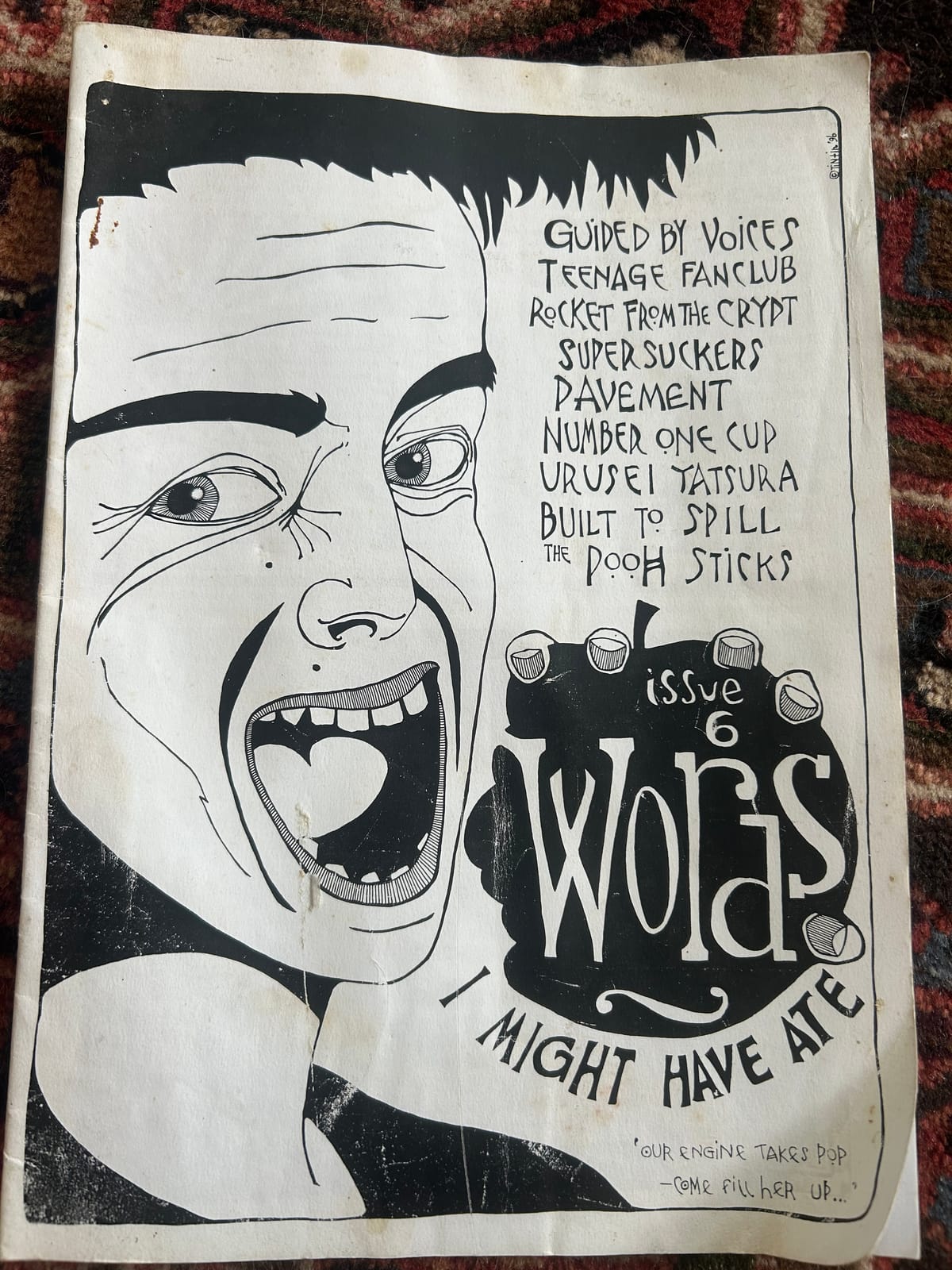
“All I’m saying is that if I ever start referring to these as the best years of my life, remind me to kill myself,” says Randy ‘Pink’ Floyd towards the end of Dazed and Confused, a film that came out in the autumn of 1993, at almost the precise time I was writing what became the first issue of my fanzine. What we are surely meant to believe, as viewers, is that Randy will live to regret this statement. He’s good-looking, popular, star quarterback of his high school football team: a kid who has the rare knack of affably straddling the social divides between the nerds, the jocks and the stoners. It’s the summer of 1976 in the suburbs of Austin, Texas, school was out for the summer yesterday, and, accompanied by his male contemporaries, a freshman apprentice he’s magnanimously taken under his wing and at least two adoring members of the opposite sex, Randy just had what he’s clearly going to eventually remember as one of the best nights of his life. Will anything ever be quite this good for him again? Perhaps. But what Richard Linklater, Dazed and Confused’s director, seems to be saying is: it’s unlikely.
I didn’t see Dazed and Confused until two and a half years after it had come out. By that time I was out of my teens, out of my driving-around-with-friends-doing-nothing-much stage, embarking on what soon, to the surprise of many people, not least me, became a career. I romanticised Dazed and Confused’s clothes, muscle cars and music, recognising sprawlingly aimless nights of my own in it, and, in Randy, a certain sporty-nerd-hippie social butterflying that echoed the later part of my adolescence. But I bemoaned my bad luck in not having turned 18 in 1976 or, perhaps even better, 1966. I had not been made for my own times, I decided, as I mooched around the charity and junk shops of Sheffield, Leicester and Nottingham, seeking out bellbottoms like the ones the characters in Dazed and Confused wore. My standpoint was a little different to Randy’s: I could never look back on the years of my late teens as the best of my life simply because my late teens had the misfortune to have taken place in the British East Midlands during the first half of the 1990s.
That’s not quite the way I see it any more. I am aware that I am unable to accurately recall feelings and emotions a person I no longer am felt more than thirty years ago which, if I could, would no doubt include bad and sad and desperate days I surely must have had at the end of my teens. But I’ve got to say, from here, in my edited perception, 1993, 1994 and 1995 look like a pretty great time to have been alive. What do I see, when I look at myself during those years? A culturally varied friend group (by Nottingham standards, anyhow) who dramatically kicked the small-minded monoculture of my unhappy secondary school years into the past. The dizzying geographical freedom of a newly acquired driving license. A resurgent economy and job market. New great records - modern records - to discover every week.
What I also see, more unusually, is a Royal Mail sorting office. The sorting office is behind Safeway supermarket on the edge of a small town on the northwest side of Nottinghamshire, close to the Derbyshire border, going by the name Eastwood: a place as unClint as could be imagined. Pit country. Union Jack country. Slagheap country. Tyre fire and chip shop country. Before I drive to the sorting office, my dad sometimes asks me to stop at Safeway to get some of the Spanish sausage he likes. Eastwood is a haven for terrible food but the Spanish sausage at Safeway is curiously good (I’m yet to become a vegetarian at this point). I buy the sausage for my dad, but never on the way to the sorting office, always on the return journey, because I am always impatient to get to the sorting office - so much so that one time I crash my dad’s car into the back of a pick-up truck on the way there. Occasionally I get to the sorting office a few minutes after it has closed, or forget the vagaries of its opening hours, and when that happens, I feel a slamming emptiness, as if the day cannot possibly contain anything else I could look forward to. In the kiosk at the front of the sorting office, usually, when it’s open, is a man called Bill, who seems about 70 at the time, but is probably about 48. He doesn’t have a particularly benevolent face yet I think of his face as benevolent because it’s the face I see when I am handed the CDs, records, letters and coins that have been sent to the PO Box number I took out when I started writing my fanzine.