Thinking About Thinking

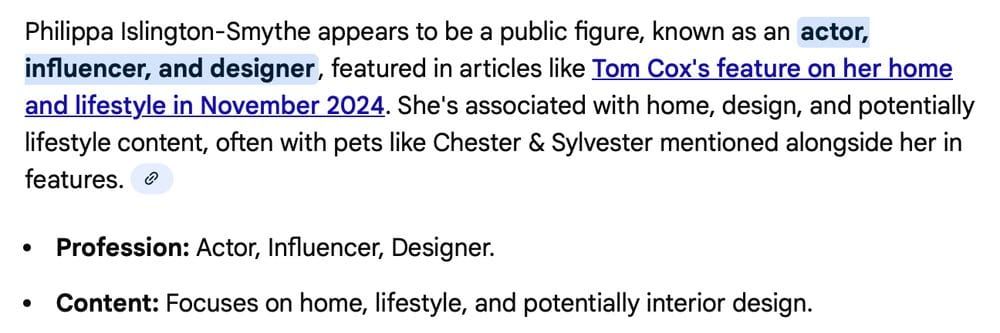
In some of the bigger news of the past week, this silly piece I wrote means Google's AI search engine is now telling people that my cat Roscoe is a real human woman who came to media prominence during the Britpop era. Not long after it offered me the information in the screenshot above, AI also began to inform us that Philippa Islington-Smythe - more typically known in our house as a black and white quadruped, who, as she approaches her 14th birthday, more and more closely resembles a bowling skittle wearing an ill-fitting, hastily-buttoned cardigan - is married to a man called Justin. The questions keep piling up. What is Justin's background and what originally brought the pair together? Could it have been their shared love of organic Gloucestershire honey and mechanically recovered meat? Who exactly are Chester and Sylvester? What have I started here and where on earth will it end?
The situation became yet more tangled a few nights ago when, under a full moon, I heard the sound of heels crunching on frost followed by four icy acrylic nails tapping on our front door. "Who could that be at so late and eerie an hour on a winter evening?" I asked my wife. It turned out to be Philippa herself. I have to admit she was looking pretty fucking good for a 59-year-old who had packed as much into her life as she had. "So what are you going to do about all this, then?" she asked, handing her designer wool blended double-breasted coat to a standard lamp she had mistaken for a member of our live-in serving staff. "You created me, so now I'm your responsibility. First off, I'll be needing a manager. These bespoke pheasant feather rucksacks are not going to sell themselves."
"I'll do it," announced Roscoe, who, pulled out of a 19-hour sleep on our bed by the tap on the door, had sauntered into the kitchen to find out what all the commotion was about. Bless her. She has always been a total godsend in a crisis.

Part of me doesn't want to write about AI at all, ever. It feels a bit like watering a garden full of poison. Also there are already plenty of people commenting about its many vertiginous tiers of evil, most of them far more clued-up than I am. But after posting about the "real" person that AI turned my cat into and then seeing the post go marginally viral on Bluesky I enjoyed witnessing some interesting discussions about what AI is doing to people's brains, in addition to its already devastating environmental impact. Meanwhile, via Facebook, I learned, from some people who feel positive about AI, that AI enthusiasts and AI itself have one major character trait in common, which is being entirely devoid of a sense of humour. But then that's the problem with the Bluesky social network: it's full of all these lefty woke snowflakes who don't want the planet to die and actually cherish their own ability to think complex thoughts. Much better to get both sides of the story by opening yourself up to people who don't read books and have offered themselves consummately to a terrifying technobillionaire-driven mind cult that, as it drains our resources, is hell bent on blotting out the last vestiges of their capacity to form any original nuanced thought grounded vaguely in reality. Or I could just delete Facebook? I probably should. Oh, I actually did? Thank fuck for that.

I can't find it right now but I've got a note in one of my notebooks from marginally over a decade ago which says something along the lines of "And so it was decreed by the prophets in ancient times that any attempt to get any creative work you had done out to its intended audience via the Internet would also mean a commitment to sending that work on a thorny journey past its unintended audience, and, lo, it did become true." Little about that has changed since 2015 but now there's the extra thorny element of a symbiotic collaboration between AI and a new kind of human whose brain seems to be moving ever closer to that of a robot entity with no appreciation of satire. The mindset here is one that does not understand that lies are lies when they are told, blatantly obviously, in the service of irony and truth yet, paradoxically, it is also a mindset that waits attendance on the language of actual lies: the language of politicians and conspiracy theorists and advertising, which says "If I spout this unmitigated bollocks with complete iron confidence, it won't matter that it isn't true."
Was the reason that - after I created a selection of fake covers of albums I'd recorded in the 60s and 70s and posted them on Substack - Google started telling people I was 78 years old just down to AI? No, it was also because a bunch of humans thought those albums were real. Which is funny. But the back room nuts and bolts driving stuff like this aren't so funny because the language that says "Your cat ran a high-end interior design business towards the close of the last century" and "You look surprisingly good for a man pushing 80 who'd already kettle-boiled his brain with disreputable Topanga Canyon acid before Nixon was in the White House" is another version of the language which says "This vast executive housing estate contains a selection of unique homes which are not in fact made out of cardboard", "The President of the United States should not be in jail" and "It's perfectly ok to bomb Venezuela because I'm scared of the potential personal repercussions on me if I say it isn't." Remember when Twitter just seemed like a place full of comedians, messing around in fun creative ways with language? Then do you remember about four years after that, when it had suddenly mutated into a conference room at the gates of hell where the entire fate of the planet got argued out? Not that the humour was completely dropped. When evil turns up at your door these days it's as likely to be carrying an overused meme as a pitchfork or an AK-47. Evil has long since learned that, with little effort, it can persuade online humour to go to work on its behalf. It's become an integral part of what They do: another way for Them to weaponise inane digital chatter, another way they can tell us two plus two equals five. But, as a rule, that humour is nearly always bad. It's "I mean this hideous insult but I'm pretending it's a joke so as a get-out clause I can say 'Oh for God's sake, it was a joke: lighten up' to you if you get offended by it" humour. When Trump is funny - and I kind of get why some people think he is - he's never funny in the way Trump himself believes he's funny.

When has the world, in its entire history, been more full of contradictions than it is right now? I suspect never. But I'm not going to say that on a social media site because before long somebody in the comments is inevitably going to turn up and say, "Well, in fact, while still relatively little-known by the layman, I think you'll find the Contradiction Enlightenment of the late 1200s is officially recognised by historians to still be THE era containing most contradictions, planetwide, especially if we are limiting our measuring criteria to most-overall-contradictions-per-head." Here I am, yet another person, using the Internet to his own benefit to be able to say negative stuff about what the Internet has turned us into.
I was thinking the other day about how the choice whether to digitally disengage or not used to feel like a personal one, whereas it's beginning to feel much more like a political one. When was the significant changeover?