A Summer's Tale
The full version of today's essay, which is about a hot dry summer, the books I've been reading during it, a little-known French film from 1996, and what we mistake for knowledge in 2026, is for paying subscribers only. If you'd like to read it you can support my writing for as little as £1.66 per month, which will give you access to my full archive and everything new I post. I've also currently got some original art by my mum, Jo, to send out to the next ten subscribers who choose to subscribe at the higher annual Villager and Help The Witch levels (the offer applies worldwide and I'll email you tomorrow to ask where I should send your linoprint).
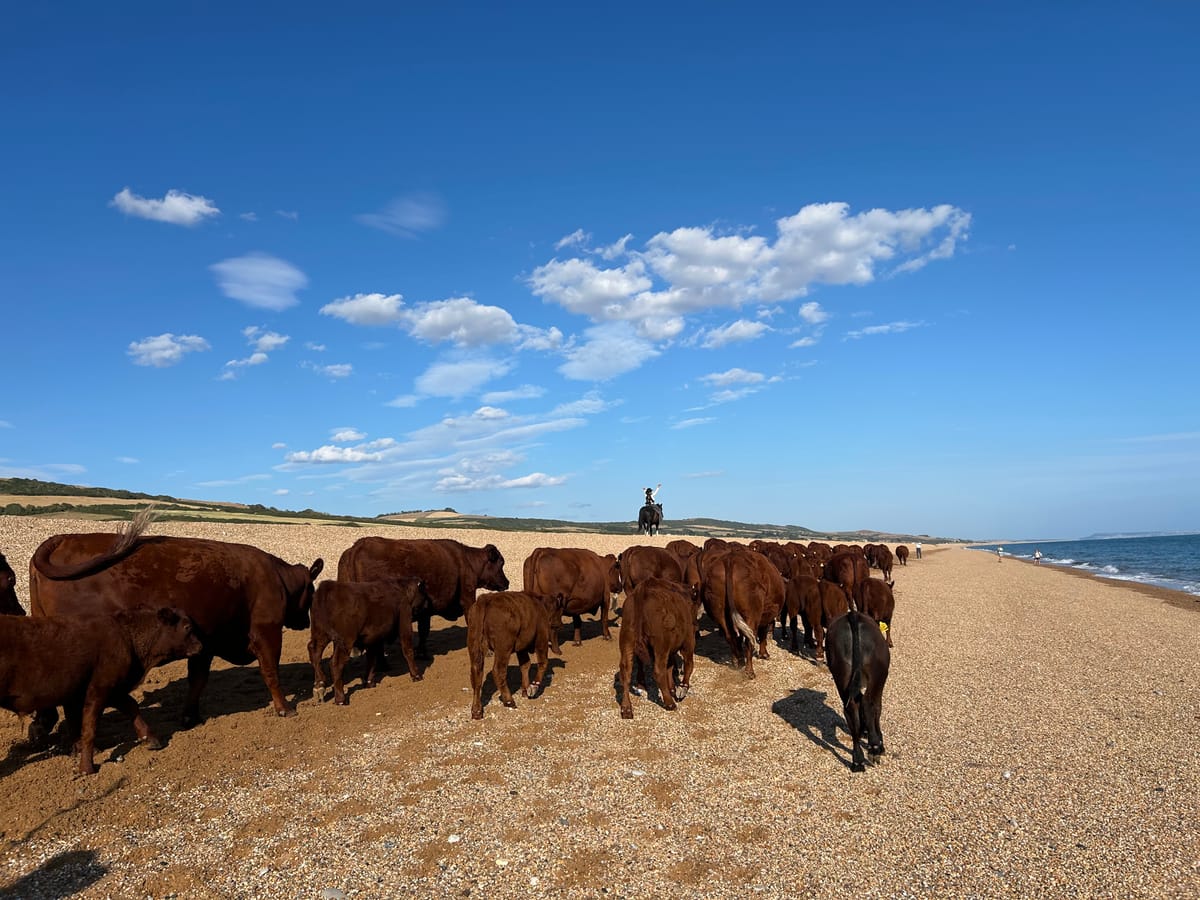
What will I remember as the highlights of my first summer as a Dorset resident? Watching the herring gull chicks on our roof grow and fledge, undoubtedly. The books I read for relief while I unsuccessfully attempted not to break my brain getting two of my own safely into the world. I also thrilled, a couple of weeks ago, at the unlikely spectacle of cattle galloping home along the beach: a thrice-per-year tradition at one of the farms that slope down to Chesil Beach, the long straight strip of shingle running from Burton Bradstock to Weymouth.
We scanned the parched surrounding meadows for almost a quarter of an hour, worried I’d got the wrong place, but then there they were, belting excitably down Cogden Marsh towards the shoreline - a herd of Ruby Red over twenty strong, although as one of their overseers, Ben, told me “we left the bull and a couple of steers back up in the field so not to complicate things”. The cows clearly relish the two mile journey but the vegetation at the rear of Chesil has thinned significantly in recent years meaning - particularly when you add the effects of the recent drought - it’s not the mobile dinner party it once was for them. That’s good for photographers like me, as it draws the herd to the shoreline, and adds to the unreality of the spectacle, but a bit worrying for the farmers trying to make a living of the increasingly yellow, biscuity land, with no sign of rain.
I swim at a variety of spots along this coast and find myself thinking about its changing shape almost constantly, in a way I never did when I lived in granite-buttressed South West Devon and Cornwall. How recognisable would its shape be if I was zapped back to 1800, 1300, the Dark Ages, Palaeolithic days? East of Eype Mouth, where a dramatic cliff fall occurred six years ago, the coast path drastically narrows, making it, at the height of holiday season, for a solo walker, a route that necessitates repeatedly flattening yourself against cow parsnip and bull thistle to clear the way for Labradors enthusiastically leading their human families to the chip shop at the bottom of the hill. At the rear of the beach you can pick a chunk of cliff up in your hand, give it only the lightest squeeze and watch it crumble to dust over the pebbles. The water, in front of you, is always new, never quite the same as yesterday’s. I swim out to get a better view of a distant dolphin but as I arrive I realise my route has been misjudged. The tide has pushed me around more than I realised. The sea’s moods flabbergast me, become part of my own. Yesterday: tetchy, unpredictable, surprisingly blue. Four days ago: slow, calm, centred. It inevitably bleeds into the books I read: Genesis, Uruguayan author Eduardo Galeano’s ambitious 1982 novel about South America’s shift from a land of myth and sentient meteorology to one of greed and genocide becomes also the story of the changing face of a small West Country beach over centuries. What was the narrative here, one day thousands of years ago, when all that could be seen was the moon above Lyme Bay, a flock of black-eyed gulls, a distant boat? The Overstory by Richard Powers is about human lives shaped by the far bigger, more patient lives of trees, but it’s also, because I’m here, inevitably about something bigger and more patient beneath me, happening within the fascinating and diverse geology of Dorset. Powers’ novel is also about the unavoidably interconnected nature of everything. As if to underline the magic of this, just after I begin it, I’m at our friend Meg’s house and I see a quote on the desk in her art studio which seems to encapsulate something I've been thinking a lot about lately.
She holds it up so I can photograph it:
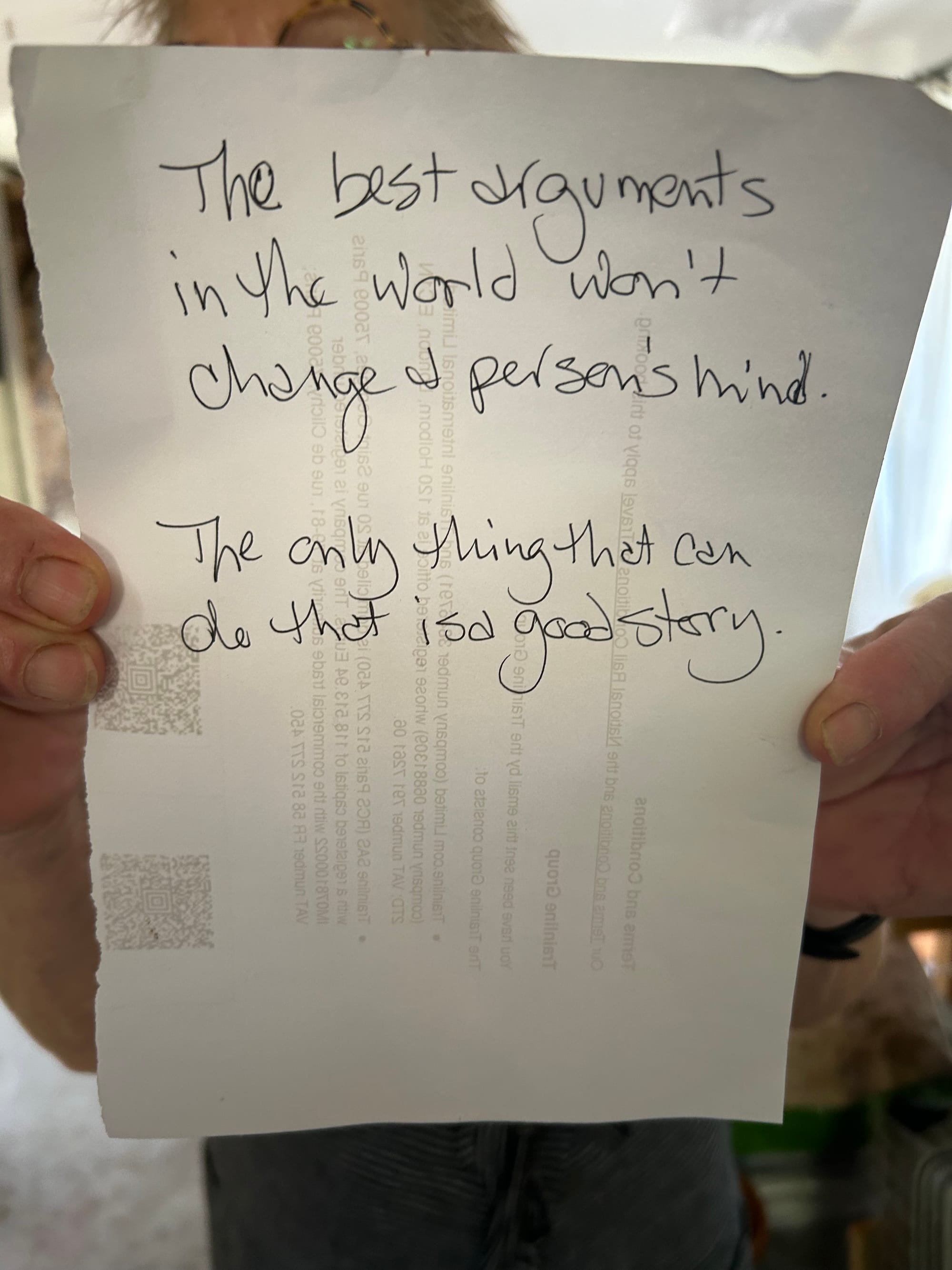
“Where is that from?” I ask Meg, who is the septuagenarian definition of electric, limitless curiosity: a person exclusively interested in everything who, after you’ve spent time with her, makes you want to do nothing with the rest of your life but read every great book, stare at every great painting, listen to every great record and revel in every aspect of the wonder of nature, which of course you already wanted to do, but never quite with this urgency and sense of importance, nor with the sense that everything else in life is just so much flimflam.