Writer's Block, Ideas Are Overrated, Please Stop Saying 'Whimsy'... And Other Things Proper Writers Are Probably Not Supposed To Talk About: A Birthday Newsletter
Writer's block is when a dazzling array of options become tyrannical, team up with an unwillingness to fail, mug you in a dark alley and stick a bag over your head.

It is my birthday today and I have writer's block. Some people persist in calling it "writers' block" but correctly the apostrophe should come after the "r'. The "block" belongs very personally to the writer in question, just as Mother's Day isn't Mothers' Day and takes many forms, all depending which specific mother you happen to be dealing with. It has its own rules and I could not be more aware that, even by admitting to the malady here, I'm opening myself up to a potential kaleidoscope of misunderstanding.
You see, I've been writing a lot. I'd go as far as saying some of what I've written has even got me dizzied with excitement at what it could lead to. Then there's the other writing I've sent out in newsletters lately, which - even though it's separate from the writing of my next novel - I don't dismiss as "nothing". And there's the to-be-published short story collection I finished a little while ago.
But it's a bit more complicated than that.
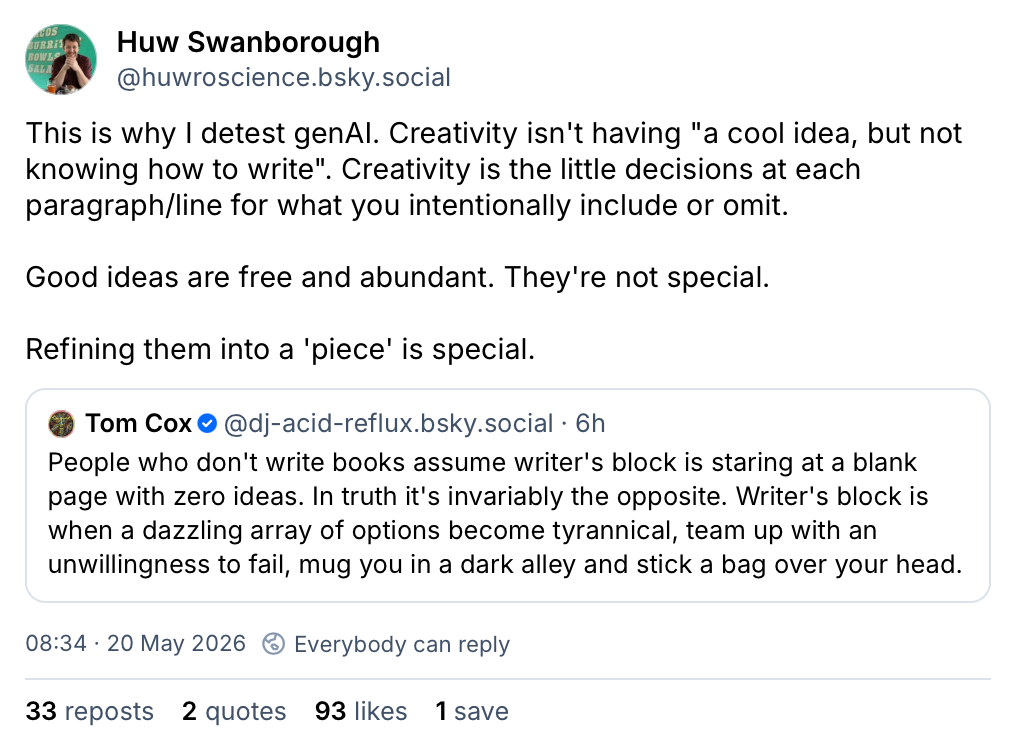
People who don't write books often assume writer's block is staring at a blank page and facing up to the fact that you have zero idea of how to fill it. In truth it's invariably the opposite. Writer's block is when a dazzling array of options become tyrannical, team up with an unwillingness to fail, mug you in a dark alley and stick a bag over your head.
But each period of writer's block has its own potted history and wider cultural context, which make it subtly different from every other period of writer's block. The wider cultural context of this one for me is the moment we all live in: a time of distraction, a time of hacks and short cuts, a time when the prevailing technological weather prompts people - including numerous influential people - to mistake ideas for art. The potted history of it, meanwhile, begins with the collapse of my previous publisher, the novel I abandoned as a result of the time-devouring cleaning-up I had to do to survive that, and the new publisher who - to my great and continuing relief - stepped in and offered to publish my latest book and republish the six previous ones. It continues with me beginning another novel last summer, then getting ill, and ending up in hospital, and abandoning that one too, but then getting back on my feet and writing the beginning of two other, slightly different novels and finishing my short story collection. There are also seven conversations which, I realise, have played a significant part in getting me to this point:
- My first conversation with my new publisher, where he explained what he wanted to do with my books, and his desire to get them to a broader audience. And where he also asked me why I'd chosen to previously publish them with a crowdfunding publisher and I explained that it was because I wanted to do something a bit better and bit more true to myself and suspected a traditional publisher wouldn't take a risk on what I did want to do, and he seemed to see my point but reassured me that, being several books on from that time, I now had the kind of following and backlist where it would be easier to get my weirder and bolder future books published by a traditional publisher (aka him).
- Another conversation with the same publisher about Everything Will Swallow You - which had felt very much like my Big Book, and which I was still feeling exhausted from - where he suggested that the book he really had the high hopes for and would have the time to put more weight behind would be the book I wrote after that: a conversation I came away from thinking, "Well, that will be good, but what I need to write first, I think, is something a little shorter and sillier as a bit of relief after Everything Will Swallow You, which in fact did nearly swallow me."
3 and 4. The conversations I had about that same shorter, sillier collection of short stories with my publisher and agent. The ones where my publisher and agent talked about how hard it would be to market, being short stories, and I gently pointed out that my 2018 short story collection Help The Witch had sold over 14,000 copies, which to me didn't seem too horrific for a short story collection, and my publisher countered that, while that was true, this latest book would be a harder sell, being less blatantly "folk horror" in theme. These conversations all led to my publisher rejecting the collection, which I sent to them in full, but saying they would still be interested in another novel from me. And me thinking, "Okay, well that's disappointing but in a way could be a blessing in disguise, because I've been fancying putting out a short book myself as an experiment and this presents a nice opportunity to do that."
5 and 6. The two conversations that followed. The fictitious one, that is, where I got a train a few hours east, walked into the office of my publishers waving around Jhumpa Lahiri's 1999 short story collection Interpreter Of Maladies - her brilliant first book, which, when she was virtually unknown, won the Pulitzer and went to number one on the New York Times bestseller list - and told them how much I agreed with them about short stories being such a hard sell, then grumbled about the fact that Help The Witch, if you've genuinely read it, isn't really much of a folk horror book, certainly not by the standards of right now, because it's far too silly, and that when I was writing it, folk horror wasn't trendy yet and lots of people I mentioned the term to thought I'd made it up. And the real conversation, where, after philosophically responding to my publisher's rejection, I went on to send them several thousand words of two in-progress novels.
- The conversation with my agent where a) he passed on my publisher's offer for one of the novels (I'm not totally sure which novel - I couldn't find any acknowledgment from anyone that I'd sent sample material from two) and comments, which was that the writing was "very him" (i.e. me), but urging me to "tone down the whimsy" (which he acknowledged was part of my "brand") which he felt had "been increasing over the books" and would make it harder to bring me to a larger audience, and b) I replied by rejecting the small advance my publisher had offered.
Which fool in their correct mind would turn down an advance - even a small one - for a partly-written literary novel, in the current shaky climate of the publishing industry? The answer is me. I'm that fool. And I believe the mind I am in - while undoubtedly a bit bruised - is correct.
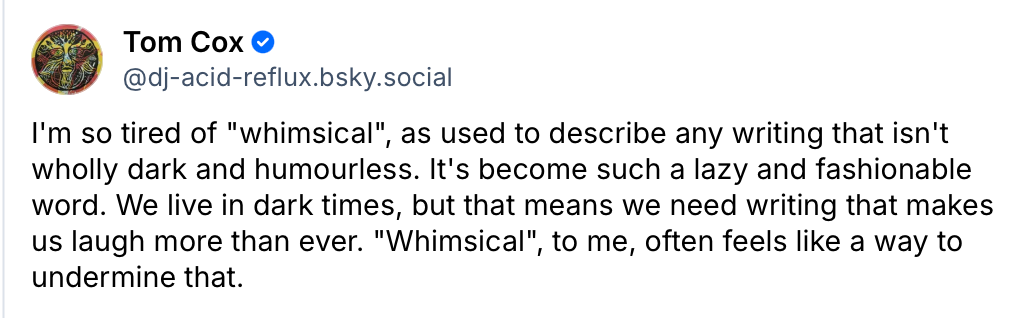
I don't think there is anything wrong with "whimsy" when people use the word by its dictionary definition. The problem is, they rarely do any more. Dismissive overuse has lately annihilated it of positive and specific meaning. It's pretty much become the "random" of the mid 2020s. When I hear someone using "whimsy" in a negative sense now, what I hear them really trying to say is "twee" and "inconsequential" - i.e. separate from the real, important business of life. It's hard not to hear "tone down the whimsy" as "cut out the bits that make people laugh and curtail your imagination's wilder, more enjoyable long haul flights", even if that's not what someone intended it to mean. My unbending view is that the world, especially now, is far too scary and serious not to laugh at. As for "brand", you'll hear plenty of people arguing that every writer has one. But what I would argue back is that as soon as an artist, writer or musician starts thinking in terms of their own "brand" they're essentially saying "I pledge to willingly rip out the very soul of what I do." I don't have a brand. Since at least 2016 my brand has been 'I Write Whatever The Fuck I'm Burning To Write At That Particular Moment Without Giving A Fuck Whether Or Not It's Trendy Or Marketable' and that isn't going to change.
But it's not because of the use of the word "whimsy" and "brand" - contaminated Satanic capitalistic henchwords that, in an ideal universe, would now be buried in the same landfill as "content", "product" and "creator" - that I turned down my publisher's advance. Nor is it the fact that it was smaller than the one I was officially supposed to receive for Everything Will Swallow You, prior to the demise of my ex-publishers, and I believe the 2000-ish copies of the hardback pre-ordered by my readers warrant a greater commitment than that. The reason I have turned it down is so I can give myself the best chance possible of writing the book I really want and need to write, and because I believe that turning it down gives me the best opportunity possible of getting over the particular strain of writer's block - or, if you prefer, something akin to writer's block but which produces more words - that I've been suffering from.
It's still early days with Everything Will Swallow You. The hardback came out in September, several people have told me they read it then immediately went back and started it again, and I just got delivery of the finished paperback. It looks beautiful, I'm excited for its publication on July 2nd, and my honest hope is, rather than it being a slightly lost cult book, that as many people as possible reading this newsletter buy it and tell their friends about it. Though I have to confess I wish I saw a few more of them in the bookshops I visit, I've been quite impressed by how my publishers are getting my books out there, considering they're a newish, small independent imprint. They were also so wise to reject the first Unbound-comissioned cover and ask Joe McLaren for a redesign, which prompted Joe to really knock it out of the park, possibly even more than he did with Help The Witch, my previous favourite of his covers. None of it is a gift horse to be looked in the mouth, especially when I consider where I was 16 months ago, feeling like my life's work had been taken away from me, with no guarantee that my best work would ever be out there again at all. A conventional publisher's goals are naturally different to those of a writer like me. They are a business. I, meanwhile, am a relatively quiet, camera-shy individual who just wants to write books and have enough of them be read for me to feel confident that I can continue writing books. The numbers that impress me probably don't impress them. They're not thinking about how deeply my writing will or will not connect with a reader or about how enjoyable the process of writing a book will be for me. They're thinking about ways to make my books more solidly successful in an overcrowded and competitive marketplace. That's good for me, in a way. But it's also not good for me, in other ways.
If they happen to be reading this, I want my publishers to know that I get it. I also want them to know that I appreciate what they are doing in their packaging and distribution of my work. I understand why my publisher chose the words he did and that he might not have known that he'd touched a couple of historically raw spots with them. I understand that he probably doesn't realise that they would have landed differently if I'd seen some positive comments from him about my books to counterbalance them during our year working together. I understand that he might think that I should take it as a given that the fact that he's published seven of my books means he feels positive about them and that I might not need any more positive feedback on top of what I receive to butter my ego from readers, every week. I understand that I have been a little sensitive. I also know that being a little sensitive is a mandatory requirement in a career where you are inventing people in your head then transferring their stories to paper, and I do try my best to stop that teetering into oversensitivity. Which is why, when I received my publisher's feedback, I did not respond in any of the more dramatic ways other writers I have met, of a different artistic temperament to my own, might have in the same circumstances. Instead, I went off to try to start yet another new book. .
I am not, however, going to write another novel for my current publishers.
I'm not saying that my current publishers definitely can't put the book out (which - who knows - they might not want to, after reading this). But I have decided, in no uncertain terms, that I will not be writing it for them. I refuse to write a book to an order that has wriggled its way into my head which says "must be better/more important than Everything Swallow You, must sell more, also pls tone down whimsy". I refuse not to give myself permission to try something out, for me, spend the right kind of time discovering what it is, and open myself up to failure in the process. Because I believe that is the only way writer's block is conquered: by flinging open the doors of the spidery chamber where failure lives.
Yesterday, for the first time since I'd sent them off, I went back over the samples of the two novels I sent to my publisher in January. I was surprised to find that I liked them a lot. Somehow, in those months, a little worm had got into my brain and decided they were not good enough. Brain worms come in many forms. Robert Kennedy Jr's makes him pick a dead bear up off the side of the road and dump it in central New York. Mine, it seems, stealthily makes me temporarily go against everything I believe in and start judging my writing on the standards of commerce, not art, which - while less weird - is also unhelpful to anyone, except the worm itself. It's the same worm that, many years ago, used to take the brash projections of failure made by privately-educated London-based people to heart and cause me to chicken out of writing the books I really wanted to. That is, before I said "Fuck it" and actually went ahead and started writing the books I really wanted to - the books people had told me wouldn't succeed - by opening myself wide to failure. And then saw that, contrary to what I'd worried about, those books wouldn't ruin my life and, contrary to what I'd been told, would be enjoyed and read by many people.
Saying quietly to yourself "I know best" is sometimes the hardest thing of all to do as a writer, especially when there's what feels like a whole industry of educated people telling you otherwise. But if I'd never done that, I'd have never have written my best books.
Are we allowed to look back on an upsetting event with nuance and ambivalence? Is that still within the rules of a culture that wants to simplify and soundbite everything? The collapse of the Unbound publishing company left hundreds of writers, artists and editors vastly out of pocket, caused a tsunami of stress in the lives of many of us and made us feel misled and, in some instances, used. Nonetheless, the fact remains that Unbound was the making of me as an author, even if it did some breaking in the process. I miss the conversations I used to have about books with John Mitchinson, its founder, his instinctive understanding of what I was trying to achieve, and the genuine infectious force of his enthusiasm for bold storytelling outside the mainstream. I miss being able to say "This is the next thing I'm going to do, and it's different from the last thing, and not like other people's books" and then, due to the support of many hundreds of readers, just going ahead and doing it, with increasing confidence, and then seeing the book in a shop, just a few months later. I miss it, because it's very different to showing somebody an idea and saying, "Please sir or madam, I realise that I live a long way from London and don't have any A-levels or a degree or any celebrity friends who will plug my book and help it sell more but I would very much like to be given permission to flesh this out and if you would just let me have the chance I would be very quiet and meek and know my place and be grateful forever" which is what I felt I was doing for the first fifteen years of this century and what I worked so hard to get away from. And I didn't work that hard to get away from it just to find myself right back in it.
I admit this fully in the knowledge that some people would probably rather I told a simpler, more redemptive story: the story of 'Unbound Bad, New Post-Unbound Publishing Life Happy Ever After'. But I admit it because it helps me get to the bottom of precisely why I've felt so stymied recently. I had learned to work one way, which I thrived and felt liberated by. And now I am being asked to go back. And I just can't. Not if I want to carry on getting pleasure from writing books.
For a long time, everything I write - and that includes this newsletter you're currently reading - has come primarily out of a desire to find out what I think about stuff, rather than a desire to tell people what I already think about stuff. And it's only by opening yourself wide to failure that you're able to properly get on that same road to discovery. It certainly doesn't come out of sitting over a keyboard, trying to tell a story, with the question "But will this all be okay for the people who want to eventually wring some serious cash out of it?" bouncing around the periphery of your vision like a floater in the eye.
Sending those two part-written novels to my publishers in January was a huge mistake. I can admit that to myself now. Both those books - at least in the form they were going to take - are dead now. They're dead because I allowed them to be evaluated as chunks of commerce when they hadn't yet gone through the all-important process of mutating from a bunch of ideas into the highly specific vision that I had for them: the same vision that could only be explained to any person outside my own brain by writing the books themselves, in full. By attaching them to an email, before their bones had even properly had chance to fuse together, I showed a lack of respect for them and, moreover, a lack of respect for the space where ideas become a big, complicated, nuanced story that is totally unique to its author. And that is an extraordinarily private space that I realise, more and more, must be fiercely protected. Ideas are ten-a-penny. That space is not. It's where the fear happens but it's also where the magic happens: a magic that can only happen if the terror is fully embraced. I think Huw Swanborough put it extremely well on Bluesky this morning...
I'm not AI. I'm not a "brand". I'm me, just some guy, from no place important, trying to work stuff out, and trying to fight for a proper space of my own to continue working that stuff out, again and again, until I can no longer do so, due to an extreme case of death.
The working out won't be automatically better because more people buy it and read it and a celebrity talks about it and it wins an award. It will just mean more people bought it and read it and a celebrity talked about it and it won an award. But it will be tepid and a let-down to me - and, worse still, might not happen at all - if I go tentatively about it, worrying about its success and whether it fits a commercial agenda, rather than throwing myself right into it and doing it my way, in total embrace of all the risks that entails.
So, I apologise if my next novel turns out not to be as good as the last one. It won't be perfect, I know that. Some malevolent twat online will be mean about it, because some malevolent twat online always is. And it will be written - as all novels tend to be written - at the expense of several others that will inevitably sidelined in attempt not to be annihilated by the tyranny of choice. But what I can guarantee is that, while writing it, I won't be working on my "brand" or toning down something people erroneously call "whimsy" - or anything else, for that matter, including the person I am. I also won't be defining what "enough" or "success" is by anybody's standards but my own.
I was going to say that sometimes you've just got to stop pissing around and worrying and go ahead and write the fucking thing but that would be a lie. You've ALWAYS just got to stop pissing around and worrying and go ahead and write the fucking thing.
It can be nice, daydreaming about what the novel you're going to write might be and sometimes it feels like a lot safer space to be in than the one where you find out just how tricky the reality might be to achieve. But nothing beats the feeling when you have made a piece of art that you're fully proud of exist in a place where there used to be just thin air.
I wouldn't have been brave enough to write a newsletter like this a while ago. I'd have worried too much about burning bridges, or pissing off my supposed superiors, the people I used to view as the sole gatekeepers of my creative future. But that's one of the good things about being 51: you get a clearer-eyed view of your own worth, what's important to you and how short life is. You know yourself a lot better and that includes knowing what frees you up and gets your motor restarted. You know how important it is for your health to write the book and do all that needs to be done to make that happen. You let yourself live by a greater honesty and living by a greater honesty often means not chickening out of what needs to be said on the grounds that you're worried about what people think of you. The truth is, people generally aren't thinking of you much anyway.
I'm fine, being alone with this process of fighting through the choice and doubt, with no idea of what's going to happen or how the end result is going to find its way out onto the shelves. It's always a bit like that anyway, really, even though there are devices and hierarchical structures you can lean on to kid yourself it's not. Confidence writes the correct book, but fear does too. Money does not write the correct book.
As you get older, you tend to desire fewer birthday presents. Today I got some gardening gloves, a breathtakingly fancy notebook, some homemade socks, an omelette with a candle on top, a chocolate meringue and a rare record from 1969. Then there was writing these four thousand words, which - although not the relaxed way in which I'd originally intended to spend the day - I'm counting as a present from me to myself.
Tom
May 20th, 2026
This was a free post but if you'd like to support my writing you can do so here and get access to absolutely everything new I post, for a minimum of £20 per year, plus an enormous archive of writing stretching back over a decade (there's also an option to make a one-off donation here).
You can pre-order the paperback of Everything Will Swallow You, with free international delivery, here. And read an extract here.